


“Those who say hemp was never meant for cannabinoids are trying to re-write history in their favor.”
By Eric Zipperle, Cornbread Hemp
There’s been talk recently from the hemp industry’s adversaries that the crop’s federal legalization was never intended to be for cannabinoid products and that companies like mine are exploiting an unintended “loophole” in the law. As someone who’s been there from the beginning, I can tell you that’s not true at all.
And I have the receipts to prove it.
In 2019, I sat in a livestock arena at Western Kentucky University and listened to the Kentucky Department of Agriculture teach farmers how to grow hemp. It was a state-run seminar, part of Kentucky’s hemp research pilot program that Sen. Mitch McConnell (R-KY) helped champion.
At one point a slide went up on the screen: “Producer Intended Product 2018.” It showed what Kentucky farmers in the program had grown their hemp for during the previous summer, before the 2018 Farm Bill was signed.
Cannabinoids: 61 percent. Grain: 18 percent. Fiber: 4 percent.
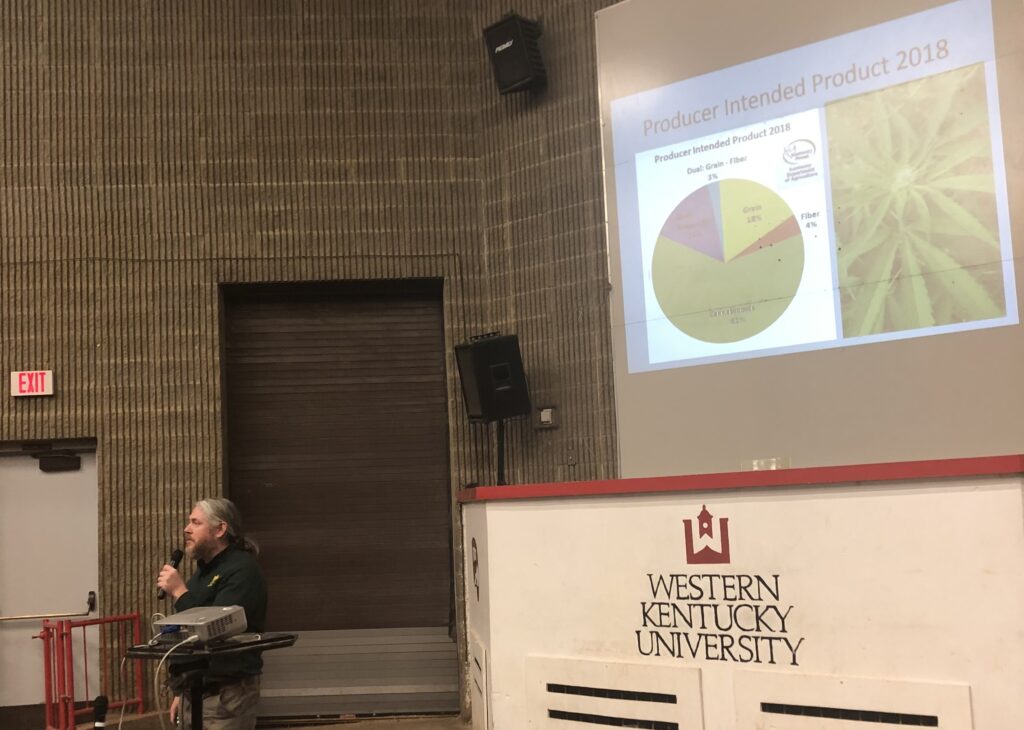
I took a picture of that slide. Every time I hear someone say that hemp was only legalized for fiber and grain, or that hemp cannabinoid products are a “loophole,” I think about that room full of farmers and that slide being projected on the wall.
Here is the history that supporters of the hemp ban are trying to rewrite, including Senator McConnell himself:
The earlier 2014 Farm Bill legalized hemp research programs so states could study the crop up close. Kentucky ran one of the largest research programs in the country through its Department of Agriculture. The state licensed the growers, approved the genetics and tracked what farmers planted and where. Every crop was tested in the field before harvest.
This was not a black market operating in the shadows. It was a government research program with government data.
Then, after four years of research, the 2018 Farm Bill was signed and expanded hemp from a research program into a real economic opportunity. Kentucky’s own numbers showed that in the growing season of 2018, before the Farm Bill was signed, 61 percent of the hemp crop in Kentucky was for cannabinoids, and only 22 percent for fiber and grain.
Nobody understood this better than McConnell.
His own state’s Department of Agriculture was publishing the cannabinoid numbers while he celebrated the win for Kentucky farmers, encouraging them to invest in hemp farming. McConnell did not get fooled by a “loophole.” He legalized a cannabinoid crop, on purpose, with the data right in front of him.
So when the same senator turned around in 2025 and wrote language to ban the cannabinoid products that he supported in 2018, he was not closing a “loophole.” He was going back on his word, and hoping everyone would forget.
We did not forget.
Companies like mine were started because of the trust we had in our elected officials back in 2018. We did not think that they would tell us to grow hemp for cannabinoids, and then ban those cannabinoids just a few years later. We built a USDA organic, GMP certified operation in Louisville with 106 employees.
Across the country, an estimated 350,000 people work in this industry. Every one of those jobs traces back to the promise of the 2018 Farm Bill.
Let me be clear, there are bad actors who are selling hemp products that McConnell did not intend for, like synthetic cannabinoids and lookalike products that are attractive to kids. But the answer to those problems is not a total ban that devastates the Kentucky farmers who invested in cannabinoid farming after the state told them to.
The Hemp Guardrails Act, recently introduced by Sens. Tim Sheehy (R-MT) and Amy Klobuchar (D-MN), solves these issues while not turning farmers into criminals. No synthetic cannabinoids, no foreign imports, accurate labels and 21+ age gating.
Those who say hemp was never meant for cannabinoids are trying to re-write history in their favor. The numbers were never hidden, never secret and never a surprise.
They were on a slide, in a state presentation, in front of a room full of farmers in Bowling Green, Kentucky on February 28, 2019.
I know because I was there, and my picture proves it.
Eric Zipperle is the CEO and co-founder of Cornbread Hemp.
Marijuana Moment is made possible with support from readers. If you rely on our cannabis advocacy journalism to stay informed, please consider a monthly Patreon pledge.


Related Posts
Congress Must Act To Make Sure Cannabis Rescheduling Actually Improves Patients’ Access Instead Of Undermining It (Op-Ed)

Allowing Hemp THC Sales To Continue Would Effectively Legalize Marijuana Nationwide, Republican Senator Says
