Massachusetts lawmakers have negotiated the details of a bill to double the legal marijuana possession limit for adults and revise the regulatory framework for the state’s adult-use cannabis market.
A bicameral conference committee has spent months working out provisions of the legislation after the House of Representatives and Senate passed differing versions last year, and the panel approved a compromise approach on Monday.
Sen. Adam Gómez (D) and Rep. Daniel M. Donahue (D), who co-chaired the conference committee, said in a joint statement that the agreement “charts a more promising path forward for cannabis regulation in our Commonwealth.”
“The legislation includes a new structure that provides clear accountability and enhances the operations of the Cannabis Control Commission (CCC),” the lawmakers, who also serve as co-chairs of the legislature’s Joint Cannabis Policy Committee, said. “The bill creates new opportunities for small businesses to grow, while providing those historically harmed by marijuana laws with temporary, exclusive access to those opportunities. This bill will allow them to realize their capital and pursue innovative models such as employee-owned businesses.”
If approved in its final form by both chambers, which Gómez and Donahue said they expect to happen this week, the bill would then head to Gov. Maura Healey (D) for her signature.
While the negotiated text of the deal has not yet been posted, Gómez said at Monday’s conference committee meeting that it represents “a forward-looking approach to modernize Massachusetts’s cannabis laws at a high level.”
“This legislation recognizes that our cannabis industry has matured and that our regulatory framework must involve along with them,” he said.
“The bill strengthens oversight and accountability by restructuring the Cannabis Control Commission, streamlining its leadership and clarifying goals and responsibilities so that the agency can operate more efficiently and transparently. We also make important improvements to public accountability by creating a new portal for reporting illegal conduct, requiring updated reporting on public health impacts and tax policy and studying workplace safety standards. The bill ensures that the industry continues to operate in a way that prioritizes safety, transparency and public trust.
This legislation also supports economic opportunity and long-term sustainability by modernizing license caps and providing more flexibility in ownership structures. We help businesses—especially small and emerging operators—remain viable in the competitive market and by expanding pathways for participation by social equity businesses, including exclusive opportunities in the medical marijuana space. We reinforce our commitment to fairness and equitable access. We remove outdated and burdensome requirements such as the vertical integration mandate for medical operators that have created barriers to entry into growth. These changes help level the playing field and ensure that our cannabis economy reflects the diversity and the dynamics of the Commonwealth.
Additionally, the bill expands safe and legal access to cannabis. It updates purchase and possession limits, it clarifies delivery rules to create consistency across municipalities and also allows for more modern and reasonable advertising practices within regulated environments. Finally, we take the important steps to address emerging issues in the marketplace, such as regulation of hemp-derived products and categories by directing further study and thoughtful policy development.”
Among the proposed revisions to the state’s cannabis law is a section that would increase the personal possession limit for marijuana from one to two ounces. Colorado enacted the same reform in 2021 after that state’s cannabis market matured.
In addition to the possession increase, which was included in both chambers’ versions, H.4206 would reduce the size and revise the organization of CCC, while also updating limits on marijuana business licensing.
Under both chambers’ versions of the bill, CCC would be comprised of three members rather than the current five. The conference committee report adopts provisions from the House measure that would allow the governor to make all appointments, rather than the Senate approach to give one of the appointments to the attorney general. Under current law, the treasurer also plays a role in appointing commission members, but that will no longer be the case if the legislation is enacted.
—
Marijuana Moment is tracking hundreds of cannabis, psychedelics and drug policy bills in state legislatures and Congress this year. Patreon supporters pledging at least $25/month get access to our interactive maps, charts and hearing calendar so they don’t miss any developments.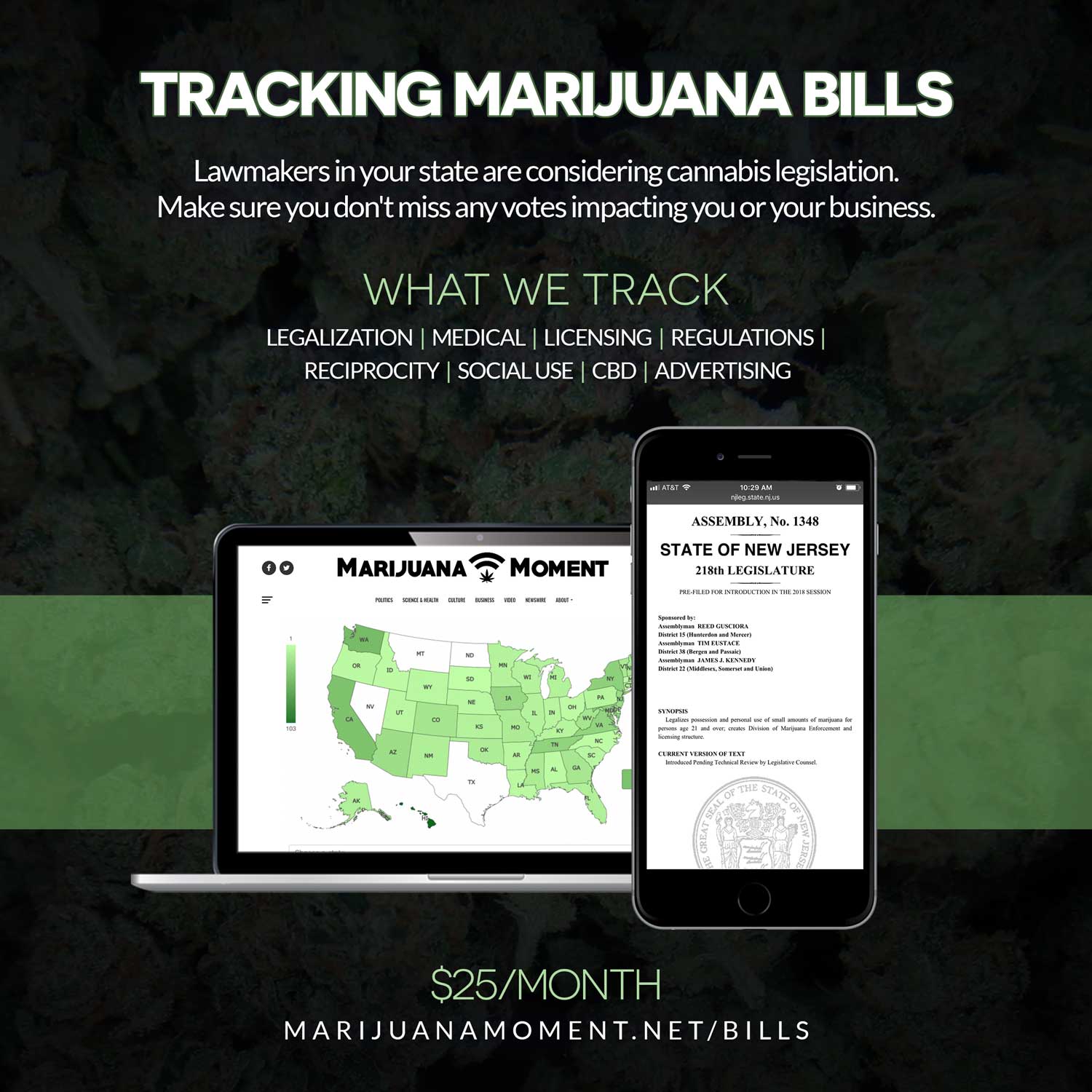
Learn more about our marijuana bill tracker and become a supporter on Patreon to get access.
—
The cannabis regulation proposal’s advancement comes as marijuana businesses in the state have filed a lawsuit aiming to block an initiative to roll back the state’s voter-approved legalization law from reaching the November ballot.
If passed, the state wouldn’t revert back to blanket prohibition; rather, it would repeal the commercial recreational sales and personal home cultivation components of the law while still allowing adults 21 and older to possess up to an ounce of cannabis for personal use.
Possession of more than one ounce but less than two ounces would be effectively decriminalized, with violators subject to a $100 fine. Adults could also continue to gift cannabis between each other without remuneration. Medical marijuana sales would remain legal.
The measure is currently before the legislature after supporters turned in an initial batch of signatures last year, and lawmakers have until May 5 to act on the proposal. If they choose not to enact it legislatively, the campaign would need to go through another round of petitioning and get at least 12,429 certified signatures by July 1 to make the November ballot.
Proponents faced skeptical questioning from lawmakers at a hearing of the Joint Committee on Initiative Petitions last month, with several raising concerns about the motivations behind the anti-marijuana measure and its implications for consumers and businesses.
A recent Bay State Poll from the University of Hampshire’s States of Opinion Project found that a majority of Massachusetts adults oppose the marijuana sales and cultivation repeal initiative.
Meanwhile, in November, the legislature’s Joint Cannabis Policy Committee advanced a bill that would require a study into legal barriers facing first responders who wish to use marijuana in compliance with state law.
Regulators would also need to look into the efficacy of marijuana in the treatment of anxiety, depression and post-traumatic stress disorder (PTSD). They would additionally examine laws and policies for cannabis use by police officers and first responders in other jurisdictions and “any other topics the commission deems relevant.”
The bill was reported out as lawmakers in a different committee approved separate legislation to provide employment protections for people who use marijuana. Another panel advanced a similar cannabis employment protections bill in September.
Meanwhile, the head of Massachusetts’s marijuana regulatory agency recently suggested that the measure to effectively recriminalize recreational cannabis sales could imperil tax revenue that’s being used to support substance misuse treatment efforts and other public programs.
To that point, Massachusetts recently reached another marijuana milestone, with officials announcing in February that the state has surpassed $9 billion in adult-use cannabis purchases since the market launched in 2018.
A report from the Cannabis Control Commission (CCC) found that legalization is achieving one of its primary goals: disrupting illicit cannabis sales as adults transition to the regulated market. It shows that among adults who reported past-year marijuana use, an overwhelming 84 percent said they obtained their cannabis from a licensed source.
Massachusetts lawmakers also recently assembled a bicameral conference committee to reach a deal on a bill that would double the legal marijuana possession limit for adults and revise the regulatory framework for the state’s adult-use cannabis market.
In December, state regulators also finalized rules for marijuana social consumption lounges.
CCC recently launched an online platform aimed at helping people find jobs, workplace training and networking opportunities in the state’s legal cannabis industry.
Separately, lawmakers are also advancing legislation to establish pilot programs for the regulated therapeutic use of psychedelics.
Marijuana Moment is made possible with support from readers. If you rely on our cannabis advocacy journalism to stay informed, please consider a monthly Patreon pledge.


Related Posts
North Carolina Governor Steps Up Push For Marijuana Legalization As State Commission Issues New Report

Louisiana Senators Approve Bill To Allow Medical Marijuana Use In Hospitals For Terminally Ill Patients