A Democratic congressman is pressing the Department of Justice for answers to a question that’s been on the minds of many Americans since President Donald Trump ordered the quick completion of the marijuana rescheduling process late last year: What’s the hold up?
In a letter sent to Attorney General Pam Bondi and Drug Enforcement Administration (DEA) Administrator Terry Cole on Friday, Rep. Steve Cohen (D-TN) asked for a status update on the pending proposal to move cannabis from Schedule I to Schedule III of the Controlled Substances Act (CSA). And he’s also asking the officials to account for why DOJ missed a deadline to issue guidelines easing research barriers into Schedule I drugs—which currently includes cannabis, as well as various psychedelics.
“It is critical that our drug laws and policies enable research and provide patients with access to effective therapies,” Cohen said in the letter, which was exclusively shared with Marijuana Moment ahead of its release.
Trump’s December executive order on cannabis specifically instructed Bondi to finalize the Schedule III rule in “the most expeditious manner.” He didn’t set a deadline for the action, but the Biden administration had already laid the groundwork for a reclassification.
There was a months-long scientific review by federal health agencies that led to the Schedule III recommendation, which received sign-off from former Attorney General Merrick Garland. It was subject to an administrative hearing process that’s since stalled out, and the administrative law judge who oversaw those hearings is now retired and has not been replaced.
“Therefore, how does the Drug Enforcement Agency [sic] plan to reschedule without an ALJ to oversee the Hearing?” Cohen asked. “What is the expected timeline for rulemaking to be completed?”
The proposed rule to reclassify marijuana wouldn’t federally legalize it, but it would remove certain research restrictions associated with Schedule I drugs, while allowing state-licensed cannabis businesses to take federal tax deductions they’ve been barred from under an Internal Revenue Service (IRS) code known as 280E.
Cohen supports ending marijuana prohibition altogether, and he’s been known to raise the issue directly with administration officials in various congressional hearings. He’s not the only lawmaker who’s taken a special interest in the topic, but the new letter to Bondi is one of the first major public attempts to extract specific answers about what DOJ is at in the process directed by Trump more than three months ago.
The executive order the president signed—which also included provisions dealing with CBD coverage under certain federal health insurance programs that is moving forward—conveyed a sense of urgency with respect to the rescheduling directive. But as Cohen pointed out, the fact that marijuana was placed in Schedule I in the first place has been a point of contention for decades, with a 1970s commission at one point releasing a report concluding that cannabis laws should be reformed.
“However, the Nixon Administration did not adopt the findings from the Commission he appointed. It has been more than 50 years since that report,” the congressman wrote. “It is my firm belief that Marijuana never belonged on Schedule I. Its inclusion resulted in harsh and disproportionate prison sentences, particularly for communities of color, and has substantially hampered research.”
“You have a historic opportunity to make meaningful progress and implement the wishes of the American people, the President, and the US under the Controlled Substances Act,” he told Bondi and Cole. “Rescheduling is widely understood to be in alignment with the best available scientific data and will significantly strengthen scientific and medical research into marijuana.”
The congressman also used the letter as an opportunity to seek clarification on DOJ’s implementation of research provisions included in the Halt All Lethal Trafficking of Fentanyl Act (HALT Fentanyl Act) that Trump signed into law last year.
Bondi missed a congressionally mandated deadline to issue guidelines by January 16 to ease barriers to studying Schedule I substances such as marijuana and psychedelics by setting new processes for research registration.
“These provisions were designed to improve access to Schedule I substances by the research community for scientific studies, and not as a legalization measure,” Cohen said, adding that as co-chair of the Congressional Biomedical Research Caucus, “I believe that scientists must be able to expeditiously conduct experiments and not be subject to undue regulatory barriers.”
“Because the DEA has not issued these regulations, scientific research using these substances has been harmed and hampered. Currently, scientists are waiting until the DEA finalizes these rules and cannot access these vital research tools, delaying important research and impacting public health,” he said. “For example, psilocybin, a Schedule I substance, has shown promise in preclinical and clinical trials as a potential treatment in depression and smoking cessation models, but access for research remains difficult.”
“Please let me know when the scientific community can expect to see the notice of proposed rulemaking regarding the research provisions in the HALT Fentanyl Act,” the letter concludes. “I look forward to your assistance and the answers to these questions.”
On the rescheduling order, Congressional Cannabis Caucus co-chair Rep. Dave Joyce (R-OH) told Marijuana Moment last month that while that reform might not be at the top of the agenda for the Justice Department or White House amid competing interests, he and bipartisan colleagues will be ready when “opportunity does present itself.”
Joyce separately said in January that he doesn’t think the attorney general would seek to undermine the president’s executive order to move marijuana to Schedule III despite any personal reservations she may have about the policy change.
A DOJ spokesperson told Marijuana Moment in January that it had no “comment or updates” to share on the topic. However, an agency official later told Salon that “DOJ is working to identify the most expeditious means of executing the EO.”
Former Rep. Matt Gaetz (R-FL), Trump’s first pick for attorney general this term who ultimately withdrew his nomination, raised eyebrows last month after posting on X that he’s been told the Drug Enforcement Administration (DEA) is actively drafting a rescheduling rule and intended to issue it “ASAP.”
There was some confusion around that point, however, as the rule is already pending before the Justice Department—and a new rule would presumably be subject to additional administrative review and public comment.
Last month, meanwhile, the White House declined to comment on the status of the rescheduling process, deferring Marijuana Moment to the Justice Department.
—
Marijuana Moment is tracking hundreds of cannabis, psychedelics and drug policy bills in state legislatures and Congress this year. Patreon supporters pledging at least $25/month get access to our interactive maps, charts and hearing calendar so they don’t miss any developments.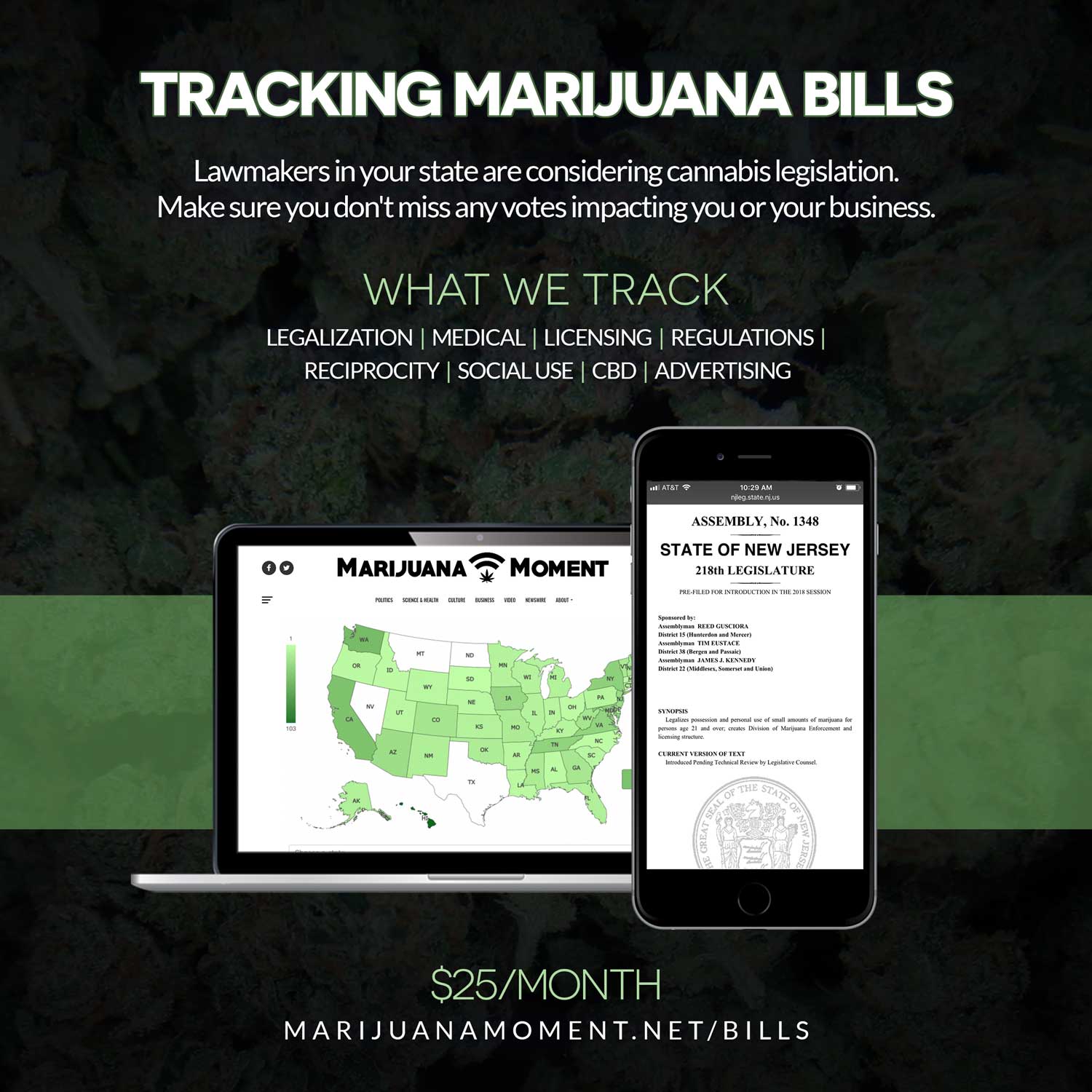
Learn more about our marijuana bill tracker and become a supporter on Patreon to get access.
—
A Democratic senator told Marijuana Moment last month that it was “too early to tell” what the implications of Trump’s cannabis order would be—saying that while there are “things that look promising” about it, he is “very concerned about where the DOJ will land.”
“The ability of the Trump administration to speak out of both sides of their mouth is staggering,” Sen. Cory Booker (D-NJ) said. “So I’m just going to wait and see right now. Obviously, there’s things that look promising—to end generations of injustice. I really want to wait and see.”
Also in January, two GOP senators filed an amendment to block the Trump administration from rescheduling cannabis, but it was not considered on the floor.
That same month, DEA said the cannabis rescheduling appeal process “remains pending” despite Trump’s executive order.
A recent Congressional Research Service (CRS) report discussed how DOJ could, in theory, reject the president’s directive or delay the process by restarting the scientific review into marijuana.
Read Cohen’s letter to Bondi on marijuana rescheduling and Schedule I research directives below:
Marijuana Moment is made possible with support from readers. If you rely on our cannabis advocacy journalism to stay informed, please consider a monthly Patreon pledge.


Related Posts

Bipartisan Senators File Bill To Support Psychedelics Research And Treatment For Veterans

[Watch] High Times’ New Travel Series Goes From Mallorca’s Underground To Portugal’s Cannabis Boom