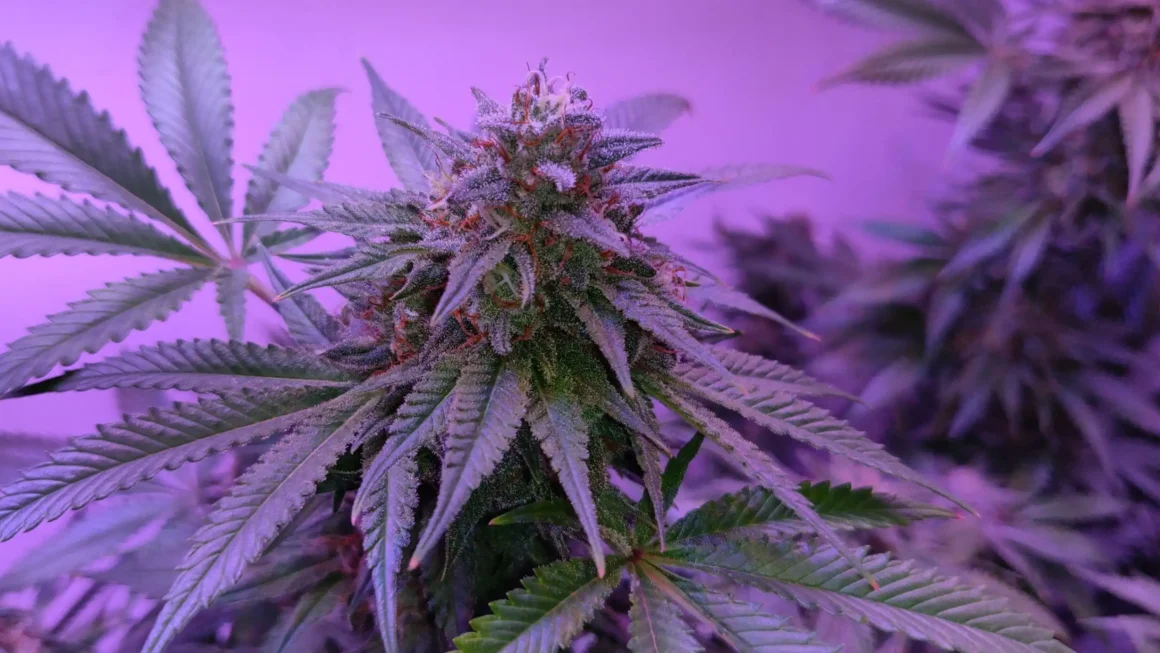
From robot canopy scanners to algorithmic breeders to AI-powered dispensary counters, artificial intelligence is remaking cannabis at every level. The question nobody has fully answered: does this help the people who built the culture, or does it replace them?
Somewhere in Fredericton, New Brunswick, a robot is watching the weed grow.
It moves along cables strung above the canopy. Slowly, methodically scanning every leaf and bud site in an 86,000-square-foot cannabis facility owned by PURPLEFARM, one of Canada’s premier genetics enterprises. The machine is called the Spyder. It was built by Neatleaf, a Santa Cruz startup founded by Elmar Mair, a former head of perception at Google X. It never sleeps. Twenty-four hours a day, it generates millions of data points on plant height, chlorosis patterns, early signs of mildew, temperature differentials between air and leaf surface. Then it feeds everything into an artificial intelligence system that suggests actions to growers.
PURPLEFARM says yields have jumped 20 percent since the Spyder arrived.
To understand the scale of what that machine is doing, consider what it replaces. On the weekend this piece came together, the author visited some agronomic field trials for hemp varieties. A team of three or four technicians and agronomists collected fewer parameters than Spyder captures in a single square meter. That manual process took at least 30 minutes. You get the picture.
Across the American cannabis industry, from genetics labs to dispensary checkout counters, AI has moved from pitch decks into actual operations. The technology is monitoring grow rooms, predicting potency before harvest, automating compliance paperwork, and deciding when to text a customer about a sale. The question that hangs over all of it — the one that matters to growers, trimmers, budtenders and small-shop owners — is straightforward: does this help me, or does this replace me?
The answer turns out to be complicated. And far more interesting than the hype suggests.
Robots in the canopy
Cannabis cultivation has always been a data problem. Indoor grows require constant calibration of humidity, temperature, CO₂, light spectrum, irrigation and nutrients — variables that interact in nonlinear ways and shift with every strain and every room. A great grower holds all of this in their head. But even the best grower cannot be in every room, watching every plant, around the clock.
Neatleaf has deployed its Spyder in more than 30 facilities, with a waiting list that now includes berry producers. iAnthus brought the system into its New Jersey grow and reported reduced crop loss through early anomaly detection. At 22Red in Arizona, head of cultivation Stephen Hess described it as a way to escape the tyranny of manually cross-referencing dozens of environmental readings. Other players occupy different pieces of the same territory: AgEye Technologies develops spectral imaging for crop monitoring; Jushi Holdings has embedded machine learning into its entire building-management system; companies like iUNU and AEssenseGrows specialize in computer vision that detects pest infestations at stages invisible to the human eye.
Some cultivators have pushed further still, using AI-powered spectral imaging to measure cannabinoid potency directly on the plant and screen for diseases like Hop Latent Viroid. In November 2025, researchers at the University of Adelaide published a method combining hyperspectral leaf scanning with machine learning that predicted cannabinoid concentrations weeks before harvest with 94.74 percent accuracy.
Applied at scale, that kind of precision will fundamentally alter how growers plan harvests and manage compliance.
Breeding by algorithm
Below the grow room, AI is beginning to reshape the genetic identity of cannabis itself. Breeding has always been slow work — pick parents, cross them, grow out thousands of seeds, phenotype the best, repeat over years. Machine learning compresses this by simulating potential crosses computationally before a single seed hits soil.
Researchers at the University of Saskatchewan and Renaissance Bioscience demonstrated that by feeding genetic markers, growth data and chemical assays into AI models, breeders can predict how combinations will influence cannabinoid content, terpene profiles and plant morphology. Companies like Phylos Bioscience and Front Range Biosciences have built their businesses around this approach.
The promise is extraordinary. The peril is equally real. Legal markets already incentivize a narrow band of traits — high THC, fast flowering, extraction-friendly architecture. AI could accelerate that genetic bottleneck, eroding the diversity that makes the plant adaptable and culturally rich. The monoculture problem that hollowed out corn and wheat genetics could arrive in cannabis on a compressed timeline, turbocharged by algorithms optimizing for quarterly earnings. California has recognized the stakes: the Department of Cannabis Control funded a study to catalog and preserve legacy cultivars. Whether the industry moves fast enough to protect those archives before the algorithms narrow the field remains an open question.
AI in cannabis: where it’s already operating
Cultivation
Autonomous canopy scanning, environmental monitoring, pest detection, yield optimization
Breeding
Computational cross simulation, cannabinoid prediction, terpene profile modeling
Processing
Real-time extraction monitoring, robotic trimming, automated packaging, contaminant detection
Compliance
Jurisdiction-specific regulatory Q&A, automated seed-to-sale reporting, Metrc integration
Retail
POS recommendation engines, personalized marketing timing, loss prevention, customer profiling
From the lab to the license
Between the harvest and the shelf, AI is making quieter but consequential inroads. On the processing floor, sensor-laden extraction equipment now monitors temperature, pressure and solvent ratios in real time. Machine learning models adjust parameters mid-run, maintaining consistent potency and terpene profiles across batches — turning what used to be one technician’s personal recipe into a continuously improving digital playbook. Robotic trimmers are getting smarter. Automated packaging lines sync with inventory systems. In the testing lab, algorithms trained on vast chemical databases help HPLC and gas chromatography systems identify cannabinoids faster and detect contaminants at levels below human perception.
Then there is compliance. Cannabis is among the most regulated industries in almost every state. Seed-to-sale tracking, testing mandates, labeling rules and sales reporting all vary by jurisdiction, change frequently and punish errors with fines or license revocation. CannabisRegulations.ai has trained a language model specifically on state cannabis statutes and enforcement actions, allowing operators to ask jurisdiction-specific questions and receive cited answers in seconds. Flowhub uses the tool when entering new markets. Prelude offers an AI-powered ERP that automates reporting and syncs with Metrc, the tracking system now running in 30 regulated markets. Solink provides AI video analytics that cross-reference POS data with camera footage to catch mis-weighing, unauthorized discounts and internal theft.
All of this — the autonomous robots, the algorithmic breeders, the compliance bots — paints a picture of an industry being remade by technology at every level. Depending on your disposition, it sounds either thrilling or terrifying. What it rarely sounds like is human.
What actually happened at the register
To get a more grounded view, the author called Rocco Del Priore. He is a computer scientist who dropped out of college with eight credits left, worked as an engineer at Apple and co-founded Sweed — a point-of-sale and retail platform that today powers hundreds of dispensaries for some of the largest cannabis companies in the United States, including Verano and Curaleaf. He has spent nearly nine years building technology for cannabis retail and is, by his own description, a pot guy. His company has an entire team dedicated to AI. He is exactly the kind of person who should be bullish on the technology’s transformative power. He kept undercutting the hype.
Sweed was among the first cannabis tech companies to pilot an AI recommendation engine at the point of sale, running a test in Arizona about two years ago. The early results caught Del Priore off guard.
“In the beginning, it wasn’t suggesting a whole lot of products that the customer wasn’t going to purchase anyway. But it was creating this really magical experience at the cash register.”
Rocco Del Priore, co-founder, Sweed
He described a returning customer walking up to the counter. The budtender pulls up their profile. Instantly, the system surfaces their usual order. The budtender says, “Welcome back. Blueberry or pear today?” Before anyone talks about upselling, something more fundamental happens: a better human interaction.
“I didn’t expect that. I thought the story was going to be about sexy sales numbers. But the budtenders were excited to have a better relationship with the customer.”
Rocco Del Priore, co-founder, Sweed
Meanwhile, the feature many in the industry had predicted would be the breakout — a guided AI tool that asks consumers how they want to feel and recommends products accordingly — fizzled. “Our lived experience did not match up with the case studies we were reading,” Del Priore said. “A small group of users engaged heavily. The vast majority didn’t interact with it at all.”
What moved the needle was something far less glamorous. Sweed built a feature called “smart sending” that uses AI to determine the optimal moment to deliver a marketing message to each individual customer, rather than blasting everyone at 2 p.m. The result: a 10 percent bump in ROI across every campaign that used it.
Del Priore had expected the opposite — the guided experience to be the headline, smart sending to be a footnote. The data reversed his assumptions.
The future is not ours to see
The tempting narrative about AI in cannabis is about consolidation — big companies deploying big technology to crush small operators. Del Priore thinks it could go the other way.
He asked for a picture of two businesses. A 150-store MSO with a four-person regional marketing team designing campaigns and building customer segmentation strategies. Then a three-store independent where one person — often the owner — handles purchasing, discounting, staffing and marketing alone. There is no way that solo operator matches the output of a dedicated enterprise team.
Unless AI does the work for them.
“If you give these people tools that will do a lot of this work, suddenly you could see a smaller chain marketing in a similar way to a larger enterprise-based chain. I think that could create a really interesting change in the ecosystem.”
Rocco Del Priore, co-founder, Sweed
He also described a near-future he called “proactive AI”: the system analyzes inventory, identifies a slow-moving SKU, cross-references it with the right customer cohort, drafts a promotional message and picks the optimal send time. The operator approves. “Instead of me going to the computer and saying, I would like you to do something,” he said, “imagine the computer coming at me and being like, ‘I think I should do something. Will you let me’?”
According to this optimistic view, AI in cannabis retail could function as a leveling mechanism — handing the analytical firepower of a Fortune 500 marketing department to a family-run dispensary in St. Paul.
425,000 workers and counting
425K
Full-time equivalent jobs in U.S. legal cannabis (2025)
$30.1B
U.S. retail cannabis sales in 2024, even as jobs declined
3.4%
Jobs declined year-over-year even as sales grew
60-90K
Positions estimated at meaningful automation risk over 3-5 years
The U.S. legal cannabis industry supports 425,002 full-time equivalent jobs, according to the 2025 Vangst Jobs Report. That figure dipped 3.4 percent from the prior year — even as retail sales grew to $30.1 billion. About 30 percent of those jobs sit in cultivation, 23 percent in retail, 17 percent in processing and packaging, and 30 percent in ancillary services. Cultivation and processing — roughly 200,000 positions — are the segments most directly in the path of automation, with entry-level roles like trimmers, harvesters and packaging-line workers first in line. By one estimate, between 60,000 and 90,000 positions face meaningful disruption over the next three to five years.
But Del Priore says the industry is already desperately short-staffed. “You go to any organization, small or large, and you ask them if they need more or less people,” he said, “and all of them are going to say more.” He attributes the shortage partly to the lack of mainstream software support caused by federal prohibition and partly to the industry’s expansion outpacing the supply of experienced talent. AI, in his view, fills gaps rather than eliminates positions.
“There’s a world in which those jobs are at risk. But the demand is so high right now that cannabis is unlikely to be impacted the way you might see software engineering.”
Rocco Del Priore, co-founder, Sweed
It is a plausible argument with a built-in expiration date. Whether it holds depends on two variables nobody can predict: the pace of legalization and the pace of AI development. If both accelerate simultaneously, his optimism stands. If the technology matures faster than the market expands, jobs will be lost. That dynamic is already visible in the year-over-year numbers.
The menu and the waiter
Near the end of the conversation, Del Priore offered an analogy worth sitting with. Imagine walking into a restaurant. You sit down, pick up the menu, read through all the dishes, narrow it to two choices. Then the waiter comes over and you ask: what do you think — the branzino or the chicken parm?
AI is the menu. It organizes the options, surfaces what you’re likely to enjoy, narrows a vast field into something manageable. But when the moment of decision arrives, you turn to a person.
The technology is already good enough to monitor canopies, predict potency, automate compliance and sharpen marketing. It will get better. Jobs will shift. Genetic diversity will need defending. Consumers should be aware of the ever-increasing impact of algorithmic marketing on what they buy and why. And the question of what happens when algorithms start deciding which brands win deserves a serious answer.
Still, there might be a version of this future that serves the culture, the plant and the people who have built their lives around both.
We will be watching.