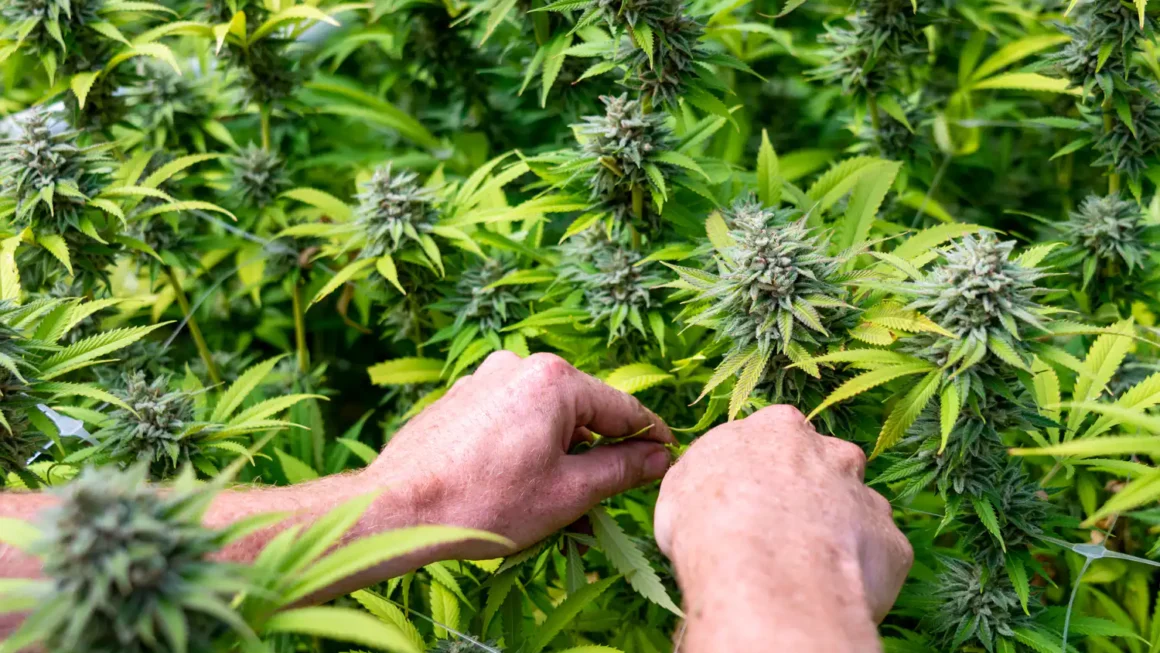
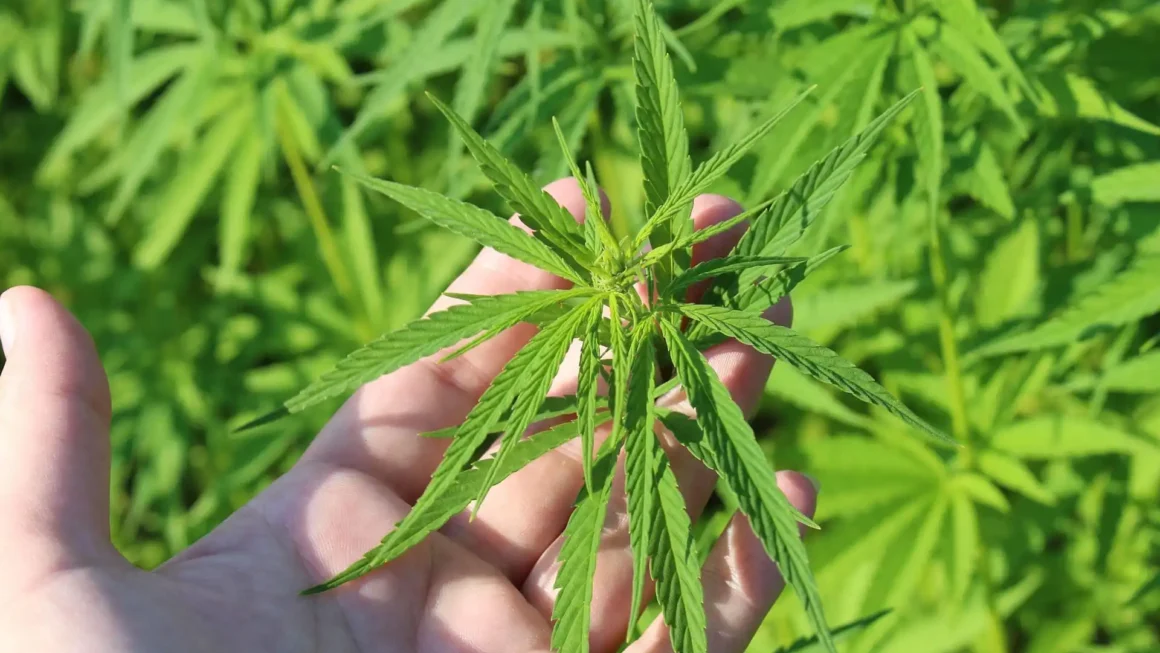
Growers used to react to their plants. Now they are learning to guide them. Crop steering is the framework behind that shift, and it is quietly changing how serious cultivators think about every irrigation, every feed, and every degree of climate.
Something has changed in the way experienced growers talk about their gardens. A decade ago, the conversation in most rooms was reactive. A plant looked hungry, so you fed it. The leaves clawed, so you backed off. The garden set the terms, and the grower answered. Walk through a modern commercial facility today, or read the threads where the sharpest home growers trade notes, and the language has flipped. People talk about drybacks and osmotic gradients. They talk about pushing a plant toward one behavior or another on purpose. They talk less about fixing problems and more about setting direction.
That shift has a name, and it has become one of the biggest conversations in cultivation: crop steering.
The interesting part is not that growers discovered a new product or a magic input. It is that they started thinking differently about the ones they already had. Water, light, climate, and nutrition stopped being maintenance chores and started being levers. Understanding how those levers work together is the whole game, and it is worth breaking down what steering actually means before anyone reaches for a controller or a bottle.
What Crop Steering Actually Means
Crop steering is the practice of deliberately influencing how a plant grows by shaping the conditions around it. Instead of treating irrigation, climate, light, and feeding as separate tasks, a grower who steers treats them as a connected set of controls. Adjust them one way and the plant leans toward lush, leafy expansion. Adjust them the other way and it shifts toward tighter, more compact reproductive growth. A plant is always responding to its environment. Steering is simply the decision to shape that environment intentionally rather than by accident.
The concept is old. As CANNA’s own horticulturists point out, people have been manipulating the growing environment to encourage certain plant behaviors for thousands of years. Greenhouse tomato and pepper growers were nudging plants between growth modes long before the technique had a fashionable name, often by something as simple as reducing water frequency to trigger a heavier fruit set.
What is new is the precision. Substrate sensors that read moisture in real time, controllers that hold climate to the degree, and irrigation systems that deliver measured shots on a schedule have turned what used to be gut feel into something closer to a repeatable process. The plant physiology has not changed. The grower’s ability to read it and respond to it has.

Two Directions: Vegetative and Generative
At its core, steering moves a plant between two channels: vegetative and generative.
Vegetative steering is the low-stress direction. It encourages long, lush growth and cell expansion: leaves, stems, and roots during a plant’s early development, and heavier bulking of flowers and fruit later on. Growers push a plant this way by keeping humidity higher, temperatures warm, and the electrical conductivity, or EC, in the substrate on the lower side. Keeping the root zone moist for longer, which is to say running a shorter dryback, reinforces the same signal.

The aim is to keep the plant comfortable so that it puts its energy into building.
Generative steering is the higher-stress direction. It reduces cell expansion, which tends to shorten a plant and shrink leaf size. In theory, those controlled stress responses can bring out desirable qualities such as tighter flower stacking and more concentrated flavor, though it is worth being honest that the full extent of those benefits is still under discussion among growers and researchers. Cultivators encourage this direction by lowering humidity, raising light intensity, and increasing the EC in the root zone. Late in flowering, a generative push can help ripen a crop and sharpen its finish.
The skill is in the balance. A plant held too long in either channel falls out of balance, and when it does, both yield and quality tend to suffer. Good steering is not about picking a side. It is about knowing which direction the plant needs at each stage and moving it there on purpose.

The Root Zone Does Most of the Talking
Plenty of steering happens in the air, but a surprising amount of it happens in the substrate. The root zone is where a lot of the real signaling takes place, and two variables do most of the work: moisture and EC.
Start with the dryback, the dry-down that happens between irrigations. Many growers track it as volumetric water content, the volume of water relative to the volume of medium. Others keep it simple and go by weight, lifting a container and watering again when it feels about half as heavy as it did right after saturation. That rough method has earned a name of its own, the 50 percent rule, and it captures the basic logic.
A shorter dryback keeps a plant vegetative, while a longer dryback nudges it generative by letting the root zone briefly tighten up.
EC is the other half of the equation, and it works through a mechanism worth understanding rather than memorizing. Root hair cells are built to pull water in through osmosis because they hold a high concentration of solutes. When the EC of the surrounding root zone is low, there is a large gradient between the medium and the root, and water moves in easily. That is a vegetative, low-stress condition. When the EC climbs, that gradient narrows, water moves into the roots more slowly, and the plant experiences a mild stress that reads as a generative signal. Growers raise root-zone EC either by feeding at a higher rate or by extending drybacks so nutrients concentrate in the medium.
This is the logic behind a targeted bloom additive like CANNA’s PK 13/14, which the company suggests using only for a short seven-to-ten-day window during the generative period. Applied at the right moment, it is one practical way to raise root-zone EC precisely when a flowering plant is ready for that push, rather than leaving it running for weeks and hoping for the best. The application also provides additional phosphorus and potassium, meeting peak flowering demands. It is an input that works as part of a steering strategy, applied when the plant is ready, rather than as a default add-on.
Here is where a lot of well-meaning growers get tripped up. They read that higher EC steers generative, or that a longer dryback firms up flower, and they chase that one number in isolation. Steering does not work that way, because the plant does not read its inputs one at a time.
CANNA frames it as a toolbox, and the framing is useful. Light, climate, irrigation, nutrition, and the root zone are not separate systems. They are one system, and they either reinforce each other or fight each other. The same osmotic pull that moves water from the root zone into the roots runs all the way up the plant: water is drawn from roots to leaves and then transpired out into the air, which means the humidity in the room is part of the same equation as the EC in the substrate. Growers track this relationship as vapor pressure deficit, or VPD, and it is a reminder that a change in the air changes what is happening at the root.
The practical takeaway is that mixed signals produce mixed results. A grower who drops the humidity to steer generative but keeps flooding the substrate with short drybacks is telling the plant two different things at once. The reward goes to the grower who understands how the variables interact and moves them together, in the same direction, at the same time. That coordination is the difference between maintaining a garden and steering it.
Why Precision Beats Bigger
It would be easy to sell crop steering as a yield hack, a trick for growing heavier. That is not really what the best cultivators are after, and it undersells what the technique is for.
Serious growers, and commercial operations especially, are chasing something less flashy than a record harvest: repeatability. They want a crop that finishes the same way this run as it did last run, and the run before that. Consistency, predictability, and reliable quality are worth more to a professional than an occasional lucky yield, because a business cannot be built on luck. Steering is attractive because it turns outcomes that once felt unpredictable into decisions a grower can actually make.
That is why the conversation fits so neatly into a larger shift already underway across cultivation. Recent reporting on the so-called No-Veg technique out of the Netherlands describes growers challenging one of the oldest habits in the book, the long vegetative phase, on the strength of hard data rather than tradition, and moving, as one writer put it, from art to science.
Other coverage of microbiome sculpting makes a parallel case: for years the garden was treated like a chemistry set where you dialed in numbers and hoped, and now it is understood as a living system a grower can intentionally shape. Crop steering is the same story told through irrigation and climate. Across all of it, intuition is giving way to intention.
Where CANNA Fits the Picture
None of this replaces the fundamentals. Steering does not overrule genetics, it does not substitute for good nutrition, and it will never outrun a grower’s experience. What it offers is another framework for understanding how every decision, from the timing of an irrigation to the humidity in the room to the EC at the root, adds up to a finished plant.
That framework happens to sit squarely on ground CANNA has been working for more than three decades. Since its first nutrient line launched in 1993, the company has built its research around the relationship between plant nutrition, root-zone management, and the growing environment, developing substrate-specific programs for coco, hydro, soil, and organic systems and manufacturing and testing everything in-house in the Netherlands.
Those are the exact variables crop steering asks a grower to command. The techniques getting so much attention now are, in many ways, the applied version of questions a company like CANNA has spent years studying. For growers, that is the encouraging part. Crop steering can sound like the exclusive property of high-tech commercial rooms bristling with sensors, but the principles underneath it are available to anyone willing to pay attention to their plants and their substrate. Steer with intention, watch how the plant answers, and adjust. The tools have always been in the toolbox. The conversation is now about how to use them.

Interested in evaluating CANNA in your licensed facility? You may qualify for an exclusive High Times X CANNA product trial. Apply Now.
Photos courtesy of CANNA
Sponsored Content Disclosure: This article was published as part of a paid commercial arrangement with CANNA USA. Product information and cultivation guidance are provided for informational purposes and do not guarantee specific results. Cultivation outcomes vary based on genetics, environment, substrate, equipment, irrigation, nutrition, and grower practices.