Dueling coalitions of police, military veterans and industry groups are pushing Congress in different directions on whether the planned federal recriminalization of hemp THC products should move forward as scheduled or be delayed.
Hemp derivatives with less than 0.3 percent delta-9 THC on a dry-weight basis were federally legalized under the 2018 Farm Bill that President Donald Trump signed during his first term in office. But late last year, the president signed new legislation containing provisions that will redefine hemp to make it so only products with 0.4 milligrams of total THC per container will remain legal after November 12.
Leaders of the Senate Appropriations Committee recently released the text of a continuing resolution to extend funding for federal agencies through December 11, past the end of the current fiscal year on September 30. Included in the legislation are provisions that will also delay the planned prohibition on most hemp products until December 11—although there is a carve-out that will allow the immediately recriminalization on November 12 of synthetic cannabinoids “that are not capable of being naturally produced by a Cannabis sativa L. plant.”
While the White House supports the delayed ban on THC products, Sen. Ted Budd (R-NC) and several GOP cosponsors, filed an amendment that seeks to strip those hemp provisions out of the bill and keep the planned prohibition on schedule.
Now, groups on both sides of the issue are weighing in as the Senate seeks to wrap up its business this week and head home for the August recess.
“Allowing this deadline to proceed without a comprehensive regulatory framework will not result in improved public safety,” a letter from Wine and Spirits Wholesalers of America, National Association of Convenience Stores, American Beverage Licensees says. “It will produce the opposite: a thriving illicit market, weakened state enforcement, economic disruption for more than one million American workers, and less safety for the very consumers Congress is committed to protecting.”
Supporters of the forthcoming ban have said it will close a “loophole” in the prior Farm Bill, but the new letter, which is also signed by the Hemp Beverage Alliance, Coalition for Adult Beverage Alternatives, Beverage Wholesalers for Responsible Regulation and Beverage Alcohol Merchants Coalition, says that “‘Closing the loophole’ is prohibition.”
“Prohibition would be a failure and risk to Consumer Health & Safety. The November 12 deadline does not create a safer, better-regulated hemp market. It creates no legal market at all, while creating an illicit market,” it says. “This is not regulation. This is prohibition.”
“The historical record is consistent: prohibition does not eliminate consumer access, improve product safety, or reduce youth exposure. Bad actors will not disappear when the legal market closes, and many consumers will have no regulated alternative. The choice before Congress is not between a ‘loophole’ and safety – It is between regulation and prohibition. We urge Congress to choose regulation.”
Meanwhile, Veterans of Foreign Wars of the United States (VFW) and its Auxiliary, representing nearly 1.4 million veterans, also sent a letter urging hemp regulation over a ban, saying that THC products “could offer a real alternative to the heavy prescription drugs so many of our veterans are given for PTSD, anxiety, pain, and sleep problems.”
“Every day, doctors hand out strong sedatives and psychoactive meds to help veterans cope. They work for some, but too many end up hooked, numb, or dealing with brutal side effects,” the letter says. “We’ve all watched good men and women get trapped in a cycle of pills that dull the pain but don’t fix the problem.”
“It’s time to look harder at safer options. Early research on certain hemp compounds shows promise for managing symptoms and reducing physical pain without the same addiction risks… This isn’t proof of a miracle cure, just clear signs we should keep studying.”
“But sweeping moves to ‘close the hemp loophole’ could slam that door shut,” VFW wrote. “A blanket ban on hemp cannabinoids would make it nearly impossible for researchers and VA hospitals to study these compounds legally. It would also hurt veteran-owned small businesses already playing by the rules. Critically, it would drive veterans looking for relief straight to black-market junk, making things riskier, not safer.”
On the other side of the debate, however, the National Sheriffs’ Association sent a letter urging lawmakers to let the ban on hemp THC products take effect as scheduled.
“This loophole was never intended to create a parallel, unregulated marketplace for intoxicating products, and it should be allowed to close rather than be renewed,” it says. “These products are marketed and sold without meaningful safeguards. Many intoxicating hemp products are available in gas stations, convenience stores, vape shops, and online with limited or no age verification, inconsistent product testing, and no standardized potency limits. Consumers often have no assurance regarding product safety or contaminants.”
The law enforcement letter also argues that hemp products are “easily accessible to minors,” saying that “sheriffs across the country continue to report concerns about these products finding their way into schools and communities.”
“Closing this loophole would not eliminate legal access to cannabis products where states have chosen to regulate them, it would simply end an unregulated shadow market that undermines public health and circumvents the very state-level frameworks that were designed to protect consumers,” the sheriffs’ letter says. We urge you to let this hemp provision expire and to support comprehensive regulation of intoxicating cannabinoid products.”
Earlier this week, a bipartisan coalition of 35 state and territory attorneys general sent a letter calling on Congress not to reverse the hemp THC product ban, saying that lawmakers’ move to enact the forthcoming prohibition “protected consumers, provided much-needed regulatory clarity, and preserved legitimate industrial, agricultural, and nonintoxicating hemp markets.”
In June, the House of Representatives passed its own version of a continuing resolution to keep federal agencies funded into December, but it did not have any provisions to alter the planned hemp product ban. As such, if the Senate passes its new provision it would then still need approval by the other chamber before being sent to the president.
Meanwhile, a number of lawmakers from both chambers and both parties have filed or are circulating a growing number of bills to prevent the scheduled federal recriminalization of hemp THC drinks and other products later this year. Until now, none of those proposals have gained traction with congressional leaders.
For example, Rep. James Comer (R-KY), who chairs the House Oversight and Government Reform Committee, is circulating legislation that would delay a planned federal ban on hemp THC products and institute some regulations—including packaging requirements, testing rules and age limits.
Separately, Rep. Andy Barr (R-KY), filed a lengthier proposal to prevent the federal recriminalization of hemp THC products and put in place a number of regulations for manufacturing, labeling, sales and taxation of hemp-derived products, including an age limit of 21.
A press release from the congressman’s office claimed that the White House supports the legislation, which is cosponsored by Rep. Angie Craig (D-MN), but the administration has not specifically endorsed it despite generally calling for hemp regulations and backing a prior similar amendment filed by Barr.
Trump and White House officials have in recent weeks repeatedly pressed Congress to delay, alter or reverse the ban.
In a letter to House Speaker Mike Johnson (R-LA) in June, for example, White House Office of Management and Budget (OMB) Director Russell Vought said the Trump administration wants lawmakers to “ensure the fair treatment of hemp products”—specifically citing Barr’s earlier amendment to keep many hemp products legal while adding regulations and taxes.
The administration “welcomes the opportunity to work with the Congress to, at a minimum, update the statutory definition of final hemp-derived cannabinoid products to allow Americans to benefit from access to appropriate full-spectrum CBD products,” OMB separately said in June, “while preserving the Congress’s intent to restrict the sale of products that pose serious health risks.”
Also in April, the president himself urged congressional lawmakers to again redefine hemp to avoid recriminalization of full-spectrum CBD products.
“I am calling on Congress to update the Law to ensure that Americans can continue to access the full-spectrum CBD products they have come to rely on, and that help them, while preserving Congress’s intent to restrict the sale of products that pose Health risks,” Trump said in a Truth Social post.
“We must get this done RIGHT and FAST, especially for those who saw that CBD helps them,” he said. “Plus, I am told it will also help our GREAT FARMERS, who we love, and will always be there for.”
Industry advocates say that the law as enacted last year not only threatens to prohibit intoxicating and synthetic cannabinoid products but also stands to remove popular full-spectrum CBD products that many Americans use therapeutically from the market.
“ONE in FIVE adults used it in the past year, and many say it improved their chronic pain enormously,” the president said in his social media post, adding that hemp-derived CBD “has made a HUGE difference for so many people.”
He also referenced a new initiative the administration launched in April to cover up to $500 worth of hemp-derived products each year for eligible Medicare patients. The program being implemented by the Centers for Medicare & Medicaid Services (CMS) focuses largely on CBD but also allows products to have up to 3 milligrams of total THC per serving. A federal judge granted the government’s motion to dismiss marijuana legalization opponents’ lawsuit challenging the initiative, but that is being appealed.
“In December, I signed a very important Executive Order calling for Research and Innovation for Hemp-derived CBD,” Trump said. “Our wonderful Dr. Mehmet Oz moved fast to follow the directive in the Executive Order, and launched a model for some Seniors earlier this month. But more must be done!”
“Please get it done, and SOON,” the president said in reference to a congressional fix for the broad recriminalization set to take effect in November. “Thank you for your attention to this matter!”
The Wine & Spirits Wholesalers of America (WSWA), an alcohol industry trade association issued praise for Barr’s bipartisan hemp regulation bill, but said the measure’s tax provisions require “continued discussion.”
Hemp policy observers expect to see a Senate companion bill to Barr’s proposal filed soon, likely from Sens. Tim Sheehy (R-MT) and Amy Klobuchar (D-MN).
Sheehy recently cited hemp legislation as an area where Republicans and Democrats can work together in an otherwise “hyperpartisan time.”
—
Marijuana Moment is tracking hundreds of cannabis, psychedelics and drug policy bills in state legislatures and Congress this year. Patreon supporters pledging at least $25/month get access to our interactive maps, charts and hearing calendar so they don’t miss any developments.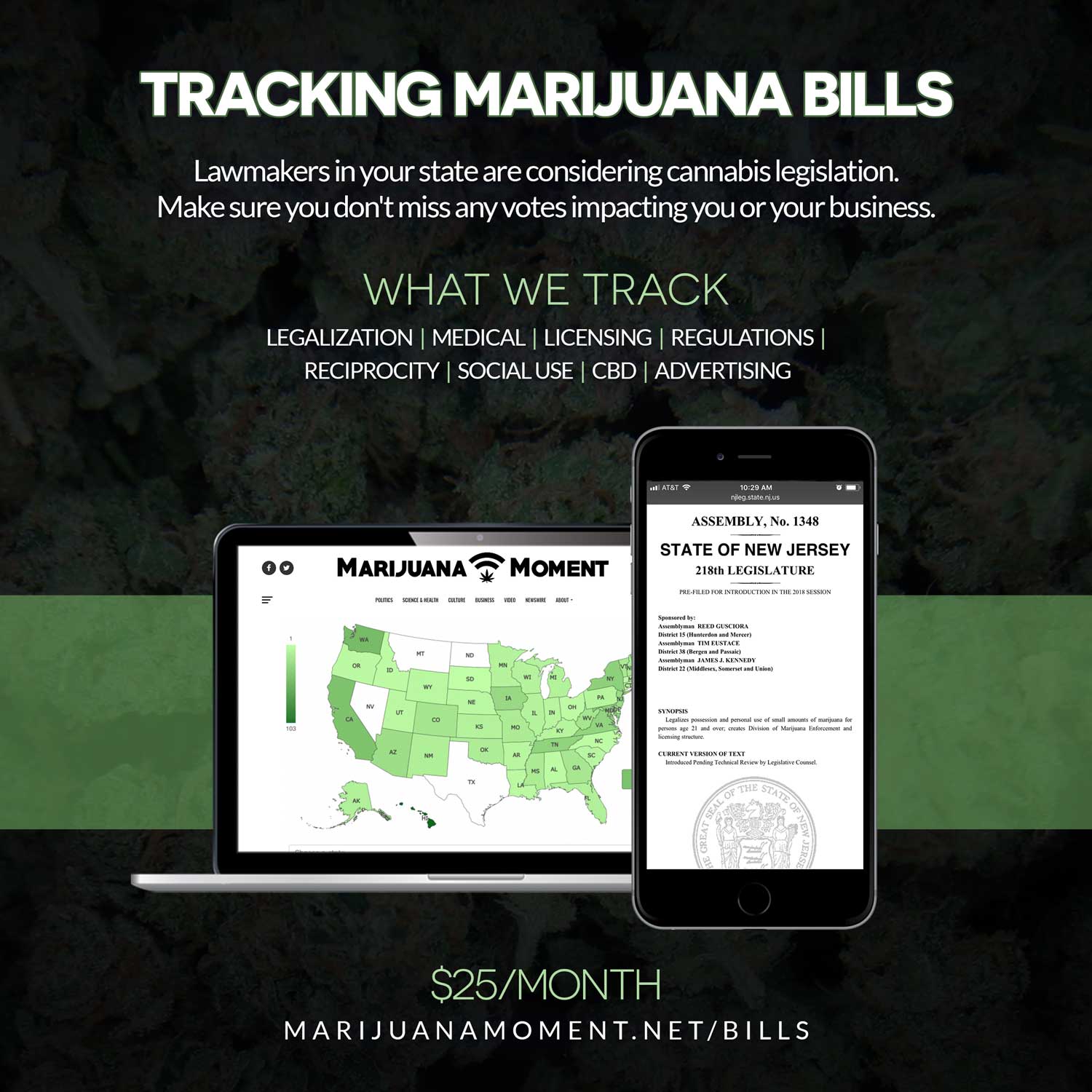
Learn more about our marijuana bill tracker and become a supporter on Patreon to get access.
—
Meanwhile, a new poll from NuggMD found that most cannabis consumers say that state-level hemp product bans that lawmakers are enacting in line with the planned federal recriminalization move are causing them to shift their purchases toward licensed marijuana businesses.
The National Restaurant Association recently sent a letter urging congressional leaders to delay the federal recriminalization of hemp THC beverages and replace it with a regulatory framework that “ensures consumer safety while meeting growing market demand” for the products as an alternative to alcohol.
Major retailer Target, meanwhile, recently moved to expand its sales of hemp THC drinks into more states.
Marijuana Moment is made possible with support from readers. If you rely on our cannabis advocacy journalism to stay informed, please consider a monthly Patreon pledge.


Related Posts
More Americans Are Now Smoking Marijuana Than Ever Before As Cigarettes Hit All-Time Low, Gallup Poll Shows
Missouri Officials Got Almost 900 Applications For Final Marijuana Microbusiness Licensing Round